canals and waterways
The idea of Canals as a form of inland transport originated in 16th century England, who used them to extend and improve the efficiency of the Natural waterway systems. In England, he length of navigable waterways increased from 650 miles to 1,200 miles during the 18th century. The idea for a system akin to this was brought to the states by Benjamin Franklin, who witnessed work on these Canals in 1772 on a visit to London. Planning for the first canal in the USA, the Middlesex Canal, began in 1793, and it was opened to traffic in 1808.
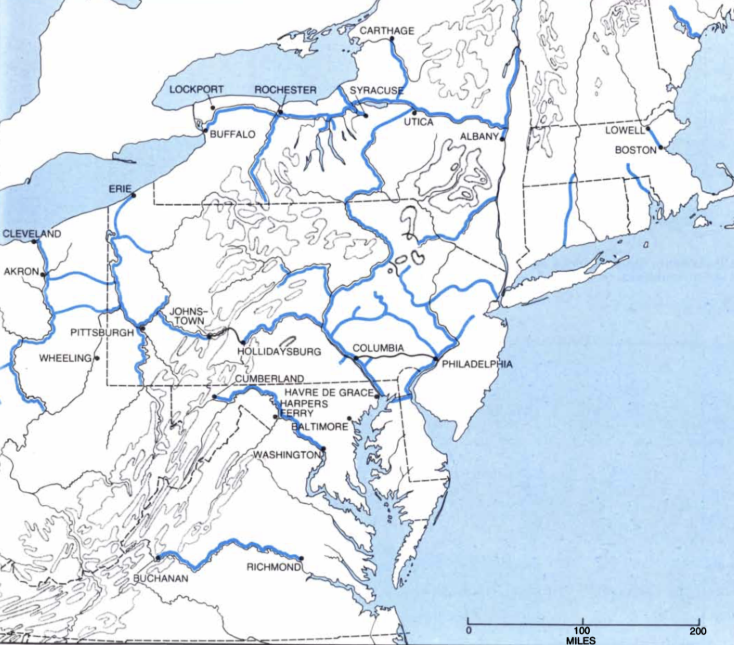
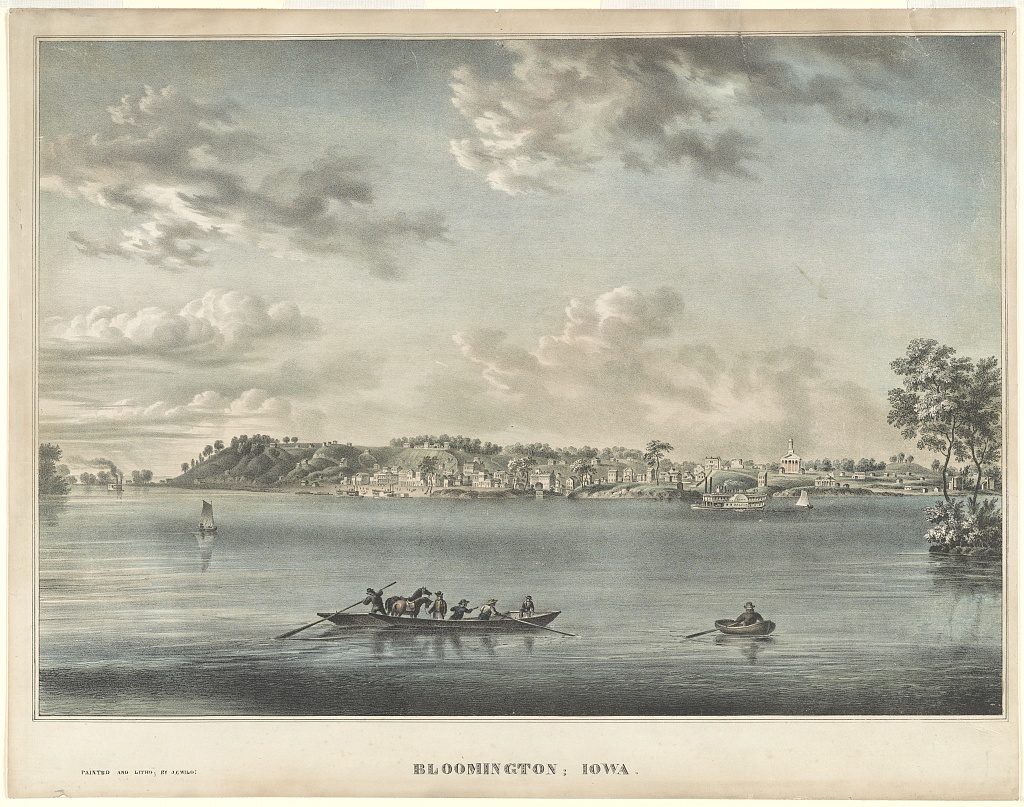
In an era of horse-drawn transport, Canals represented a move towards much more efficient modes of transport.
Horse-drawn barges could carry up to 50,000kg, compared to 2000kg in a horse drawn wagon. This made canals especially useful due to the lack of paved highways in the USA in the 18th century.
Furthermore, it was found that a big contributor to American economic growth was ‘regional specialisation’, where each region produced goods according to its advantages and availability of resources. However, this meant development was limited due to lack of efficient transport between regions.
Canals, therefore, became significant in providing an efficient mode of transport, of both people and freight, across the country. By 1860, a system of canals stretching 4,250 miles had been constructed, costing approximately $190 million.
In terms of wilderness, Canals represent a distinct way in which humans have attempted to ‘tame’ wilderness, by adjusting or even creating new waterways for our own interests.
They represent an intersect between nature and technology, therefore raising questions about the extent of human interference in areas that could have been considered ‘wild’. In terms of American expansion, the study of canals fits into the wider idea of European settlers using the American wilderness for their own personal gain, exploiting it for economic growth.
Arguably the most significant canal built in the 19th century was the Erie Canal, which connected the Great Lakes to the Atlantic Ocean, providing a solution to the barrier of communication between the East and West of the USA.
Erie was one of five canals proposed in 1808 by Secretary of the Treasurer Albert Gallatin, and the first built. Work began initially in 1812, however war debts meant it couldn’t be funded by the federal government, and opposition amongst city politicians and New Yorkers meant its authorisation was rescinded in 1814.
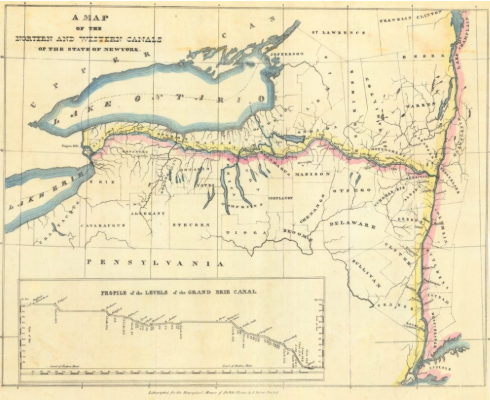
Despite this, in 1815, Mayor of New York De Witt Clinton rallied support for the canal, gained the support of 100,000 New Yorkers for the “Act for Improving the Internal Navigation of the State”, granting limited funding for the project.
It was then proposed that the rest of the funding would come through tolls and nuisance taxes. These proposals allowed work to begin in 1818, which was completed in October 1825.
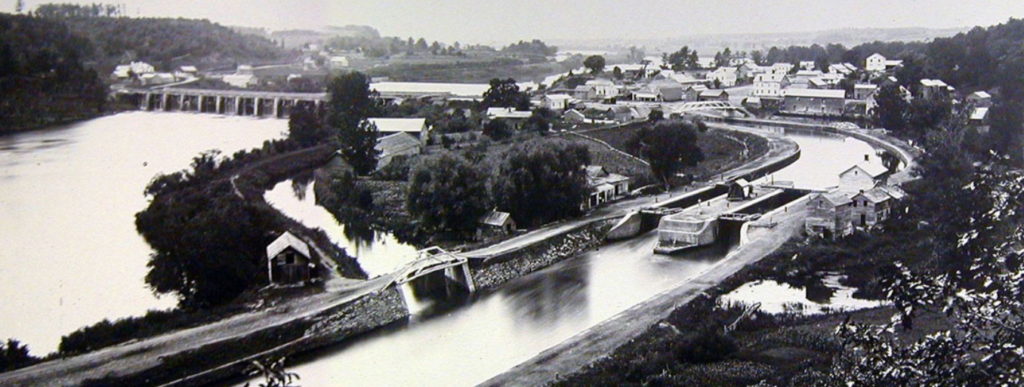
The significance of the Erie Canal came from its ability to move people and freight across areas that were previously extremely inconvenient or expensive to cross, particularly dense forest.
This highlights the significance of the canal in the history of American wilderness, as it demonstrates a key example in how white Europeans ‘tamed’ the wilderness in order to further their own interests, which in this case was the efficient movement of people and products across the country.
In 1822, even before construction was completed, 1,800 barges were transporting people and freight, demonstrating significant strides forwards in the quest for more efficient transport. Furthermore, it created a challenge which resulted in investment in the building of more canals, many of which functioned to service the Erie Canal. This makes the building of the Erie canal a significant moment in the history of American Transport.
The building of canals like Erie could not have gone ahead without significant contributions from the immigrant population. In particular, the Irish community played a significant role in canal building.
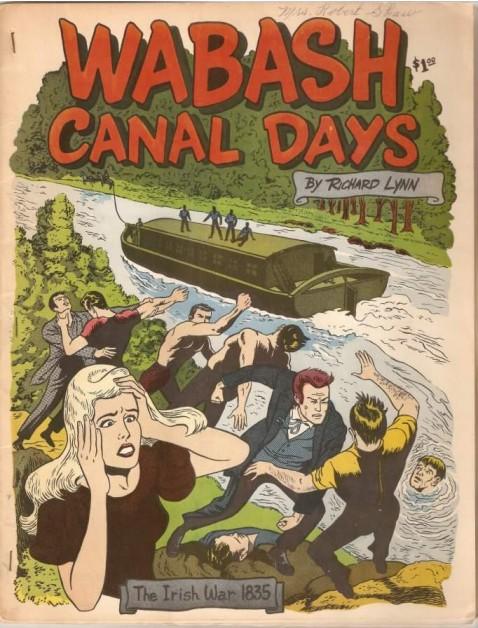
One event which stands out was the feud between rival groups of labourers referred to as the ‘Corkonians’ and the ‘Fardowns’, who were working on the Wabash and Erie Canals, who staged a fight in Lagro, Indiana, dubbed the ‘Irish War’.
This conflict has historically been explained away as caused by religious divisions, using harmful ethnic stereotypes to diminish the concerns of the workers. In reality, the conflict was more complex and reflected wider concerns within the Irish community of their economic position. One main motivator of this conflict was their desire to continue to access work on railroads and canals throughout the USA. While it can’t be denied that there was a pattern in the use of violence amongst these immigrant groups, the fact that outbreaks like the ‘Irish War’ at Lagro have been consistently dismissed as religiously or regionally motivated demonstrates a lack of awareness or appreciation of the history of immigrant labour on the canals.
In particular, this ‘Wabash Canal Days’ poster encapsulates the use of harmful stereotypes used to explain away these conflicts, in order to avoid the question of the treatment of these immigrant workers, and ignore their contributions to the canals in the 19th century.
The question of whether the system of canals was successful or not is a highly contested one.
irstly, it can be argued that there was no ‘system’ of canals in the first place. When studying the history of these canals, it becomes clear that there was no coherent plan or common aim amongst the builders of these canals. Therefore, it is difficult to give a definitive answer to the question of whether these canals were a success. From an economic standpoint, many of these canals failed to make a profit, making them a failure on paper. The canals were also quickly made ‘technologically obsolete’ by the introduction of the railroad. While 4,250 miles of canals had been built by 1860, in the same year over 30,000 miles of railroad had been built, showing a clear takeover.
However, the social value can’t be overlooked; these canals provided some of the first steps towards economic unity and growth within the USA, due to their efficacy when compared to transport by horse drawn wagon. The construction of the canal network also provided crucial employment for newly arrived immigrants, drawing on communities who had little else to offer but their labour when they first arrived in the US. Despite being largely unsuccessful in the long-term, it it undeniable that the canals maintain their place as a significant milestone in the history of American transport.