land allocation
Land distribution was one of the central driving forces behind westward expansion due to the opportunities it provided for those who wished to move west.
Economic hardship was the main reason for the push of European migration due to the lack of opportunity in Europe and difficult social mobility.

The government, newspapers, and railroad companies actively promoted and advertised western settlement through articles and posters that presented the lands of the west as a consumer product that successfully enticed immigrants towards.
The land however was not distributed evenly at all. Whilst white European settlers were offered 160 acres of land to farm and own, thus becoming a part of the American capitalist society, other immigrants from China and Mexico for example were not provided the same opportunity due to racial exclusion and discrimination. Additionally, advertised as ‘free land’, this land was not empty due to the indigenous peoples that had shaped the lands for centuries, resulting in forced removal to make way for the white settlers to become landowners. The Homestead Act is a clear representation of opportunity for white settlers through the land distributed to them but direct dispossession for Native Americans.
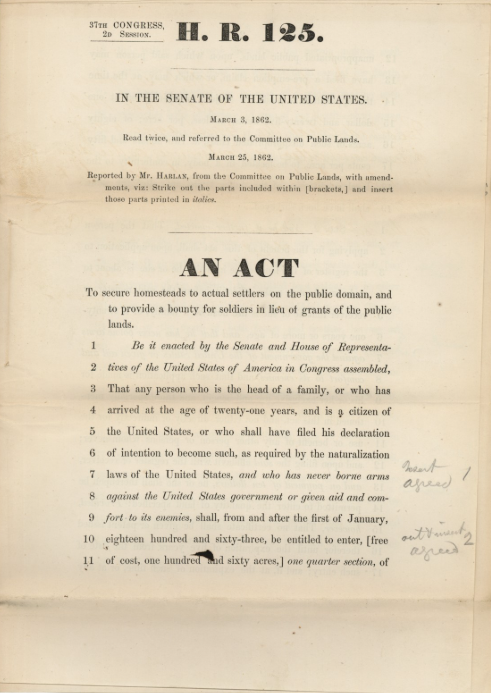
The 1862 Homestead Act
The Homestead Act of 1862 offered 160 acres of public land to settlers who would live on, improve and farm said land for five years. This resulted in huge incentives for immigrants due to the easy access to becoming a landowner, which for many in Europe and Eastern America seemed to be impossible at the time.
This image directly shows how the government split up public land to those ‘entitled to enter’.
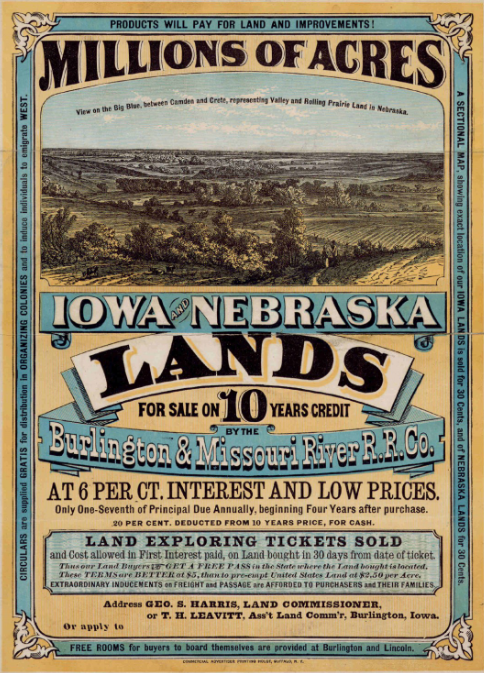
These adverts highlight the way in which the US government would commercially distribute and split up land. Additionally, the use of pamphlets across Europe resulted in Scandinavians, Germans, Irish and other Europeans to move west with the hope of being independent farmers and therefore landowners.