case study: Chinese workers
The role of Chinese workers on the transcontinental railroad between 1865 and 1869 provides a case study for the lack of awareness and appreciation for immigrant labour. These Chinese labourers have previously been systematically erased from history, with historians being left with very little primary source material available to try and reconstruct the lives of these workers. As a result, most of our knowledge comes from white Europeans, which includes photographs and memoirs. This means it is essential to read against the grain when researching the impact of Chinese immigrants on the railroad and in American wilderness history.
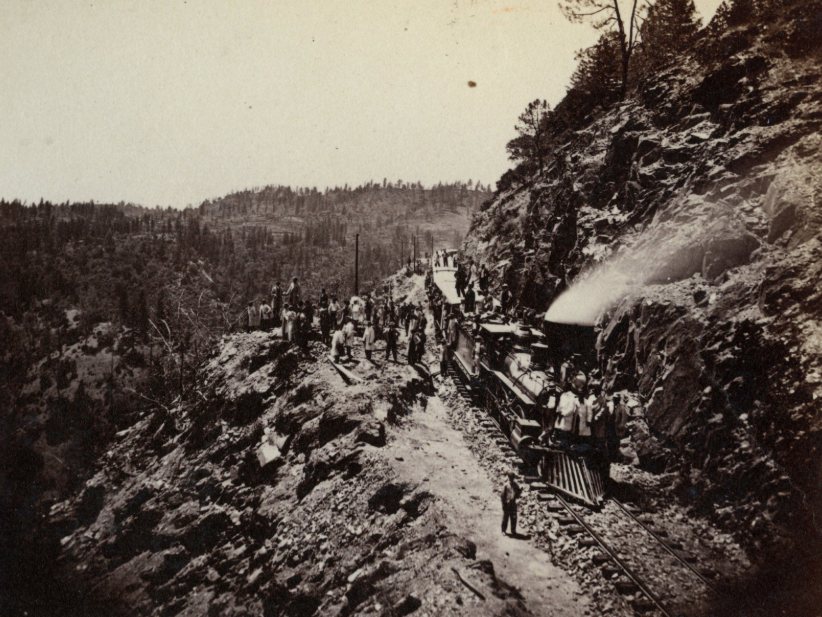
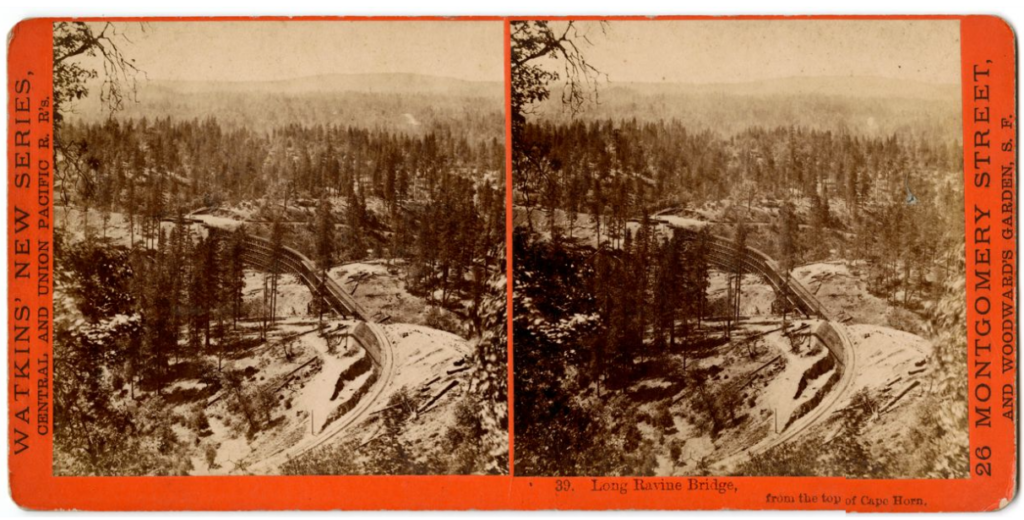
Photographs are one of the main forms of primary source we have available when studying the contributions of Chinese railroad workers. Many of these photos were taken by Alfred A. Hart and became significant both in the study of American wilderness, and later of Chinese railroad workers. Crucially, the photographs feature both the workers and the railroad against the backdrop of the Sierra Mountains. This ‘majestic’ background distracts from the workers, particularly from the abhorrent conditions they were working under. These photos, therefore, serve to minimise the effort of the Chinese workers, by emphasising the wilderness they worked in, framing the railroad as part of American culture and identity, rather than as the product of immigrant labour.
During the building of the railroads, Chinese workers were consistently demonised by their white bosses and counterparts.
This, paired with the fact that most primary source material comes from white European bosses, means harmful stereotypes of Chinese immigrants have lived on, resulting in racism against the Chinese community.
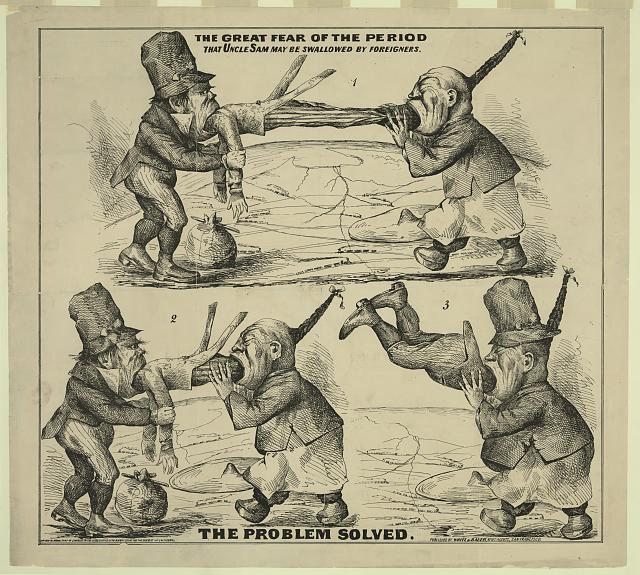
One example of these harmful stereotypes concerns the alleged violence of immigrant workers on the railroad, perpetrated in the memoirs of General Grenville M. Dodge, Chief engineer on the Union Pacific Line. He claimed he witnessed ‘skirmishes’ between Chinese workers on the Central Pacific Line, and Irish workers on the Union Pacific Line. However, these interactions were completely made up, as the Irish and Chinese workers never interacted. However, by perpetrating this rumour, Dodge contributed to the idea that immigrant workers were inherently violent and ‘uncivilised’, allowing for white Americans to ‘claim’ the railroad, erasing the work of immigrants in building the railroad.
The problem of the demonisation of immigrants can be seen in the above cartoon, where derogatory caricatures of Chinese immigrants can be seen swallowing Uncle Sam, created in the 1860s. This reflects fears of ‘uncivilised’ immigrants, which resulted in efforts to exclude immigrants and their achievements from the railroad as a symbol of American progress.
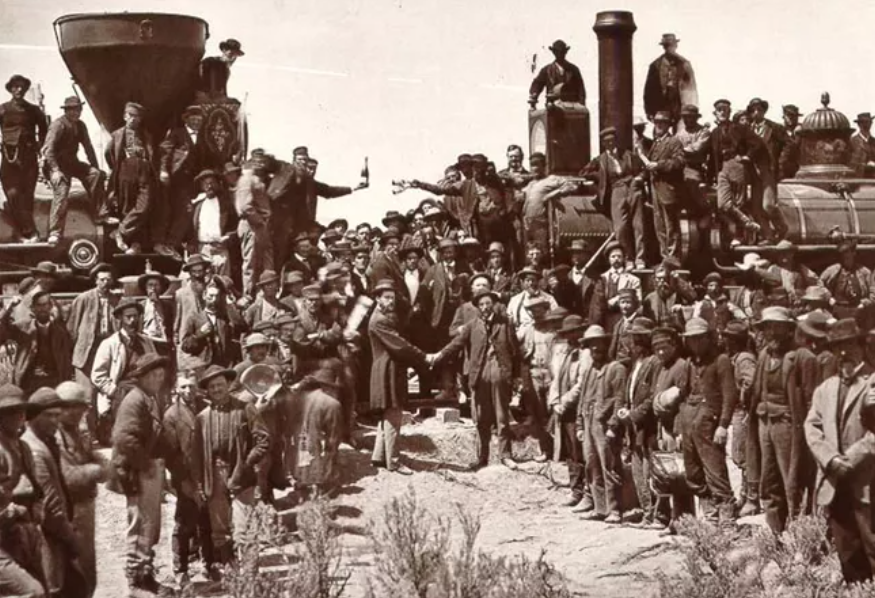
When the railroad was completed on the 10th of May 1869, railroad workers from both the Union Pacific and Central Pacific Companies met at Promontory Summit in Utah. Andrew J. Russel proceeded to take this photograph of workers from both companies, meant to symbolise the union of the two railroads, and thus, unity across the United States.
The railroad was a significant symbol of American progress and identity. However, this photo crucially excludes the Chinese workers, further demonstrating efforts to distance the work of Chinese immigrants from the railroad, ‘claiming’ it for white Americans.
The systematic exclusion of Chinese immigrants did not end with the railroad. In 1882, the Chinese Exclusion Act was introduced, designed to severely limit the number of Chinese immigrants entering the United States. This law marked the first ‘skill based’ restriction of immigration and was arguably motivated by the demonisation and systematic exclusion of Chinese railroad workers. It placed restrictions on ‘unskilled’ Chinese workers, allowing only merchants, even then only after lengthy interrogation.
This diminishes the work of Chinese immigrants in creating the American landscape, painting them as ‘unskilled’ when they were often carrying out work that required more skill than their white counterparts. Therefore, the Chinese Exclusion Act perfectly represents the systematic erasure of the contributions that Chinese immigrants made in the American wilderness, in an attempt to ‘reclaim’ the wilderness for white Americans as part of their identity.
oral histories from descendents of Chinese railroad workers
These are excerpts of interviews from the Chinese Railroad Workers in North America Project at Stanford University, you can view their full site here.
click here for the full interview transcript and video